Saturday, March 17, 2012

Do You Sing in the Shower?

I know I do.

I warble vocal warm-ups, and sing showtunes, and try to squeak out the Queen of the Night's famous aria from Mozart's "The Magic Flute" while shampooing my hair.

I also walk around campus whistling, I hum in the kitchen, and I drum out rhythms on my computer desk. Most people in America would probably classify me as a bit of a music nut. My friend just the other day was describing someone to me that they thought was a little overly artsy, and gave as an example the fact that that person sings while walking around campus.

Ooooh... burned! So do I.

Why does this seem weird to us in the USA? Knowing that I go around randomly singing, people would probably classify that I'm somewhat of a "musical person," and nod their heads in understanding once they heard I was from a "musical family."

Interestingly enough, other cultures don't have the same perspective on daily music that we do. In Liberia and other parts of West Africa, for example, all young men and women go through special training as part of their coming-of-age, which includes training in music and dance. Everyone is expected to be at least somewhat musically proficient, and they mix music into everything they do. Sometimes people march around town in the morning, singing a good-morning song, and everyone joins in the procession. When they are working in the rice fields, they sing a song and beat on drums so they can work in time to the music. In Ghana, even the postal workers, when cancelling stamps, devised a song that they whistle while creating an intricate rhythm with the stamps.

Now, I could be wrong, but it seems like the last time I was at a post office in the good old USA, it was silent, grim and gray. Emphasis on silent.

In Brazil, music is also enmeshed in daily life. In the past, Brazilian slaves who were trying to escape invented Capoeira, a sort of martial arts that they disguised with music to make it look like they were dancing. I was talking to a friend the other day who has spent a lot of time in Brazil, and she told me that there are always some kind of street performers out on the streets playing music and dancing.

Yet if I were to dance in the middle of Brigham Square and sing at the top of my lungs for long enough, I would probably end up in the campus paper.

I realize different cultures value different things, such as Canada's interest in hockey and Brazil's passion for soccer, but it seems to me that musical expression is a universal language that transcends the boundaries of nations. While not everyone can kick a soccer goal or skate on ice, pretty much anyone can listen to music. It seems very sad to me that our culture is missing the joy of integrating music into everyday life.

Imagine if you went into the DMV and the grim officials pulled out keyboard and sax and drums and jammed for you while you waited.

Imagine what your daily bus ride would be like if the bus driver sang showtunes.

Imagine what the wait would be like if you were sitting in the doctor's office and the receptionists started typing in rhythm and tapping their pencils and singing scat syllables.

Imagine what it would be like if you were waiting in a long line at a ticket office and everyone in line started clapping and singing while they waited.

I realize some people are easily distracted and annoyed by music, but I would love having it everywhere.

The USA has such a great musical heritage, and I would love to see us make the best of it. I would love to see music integrated into the daily American lifestyle.

This isn't just a fantasy - it has certainly been possible elsewhere. If you were in a post office in Ghana, you would hear something like this:

Sunday, March 11, 2012

Crazy? Me? Well... Maybe a Little...

I may be a bit crazy. Here's why:

This week I had my interview for BYU's Elementary Music Education program. I interviewed with a wonderful man, Dr. Jerry Jaccard, who I respect immensely. The interview went well. He stood up at the end, shook my hand, and thanked me for coming.

No, that's not crazy. Here's the crazy part:

I didn't just say goodbye and get me out like a sensible person would. I asked him if I could ask him a question. He said sure. I explained I was working on a section of an e-book about music education, and wanted to ask him a question about the topic.

Our conversation went something like this:

Me: You believe children are inherently musical, right?

Dr. Jaccard: Yes...

Me: In light of that, why do you think children should learn music in school as opposed to elsewhere?

That question opened up a well of information.

Dr. Jaccard said that although all children may not be able to develop their musicality to the same level, each child should be taught to develop their musicality in order to obtain a well-rounded educational experience. He feels children will have a use for a musical education in their future lives, whether they will use it someday to be teachers, performers, or just appreciative audience members. He also told me he feels schools should work with home life to teach children music, and cited examples of several school programs of various nationalities that do well at that, especially the music education program in Finland. He went on to tell me how music is quite compatible with scientific ability, citing Einstein as an example of one who is renowned for his brilliancy in math and science, but who was also, I found out, a prestigious violinist. Dr. Jaccard even told me a great story about Einstein being kept out of a performance in a queen's palace by a new guard who thought this scraggly, hobo-like man was a crazy fellow come to assassinate the queen with a gun hidden in a violin case.

When Dr. Jaccard finally saw me out of his office, there were already two other applicants waiting for their interviews.

I would have liked to have recorded him - obviously I can't quote the interview verbatim - but I thought that, in light of the circumstances, that might be taking it a wee bit too far.

A crazy person interviews the interviewer, but for someone to actually record the interviewer... well, they have nice padded cells for those sweet folks.

Arts Education in the 19th Century

Technological advances in the 19th century greatly influenced the spread of the arts.

For example, formal music education in the United States was introduced in the 19th century when Lowell Mason and George Webb founded the Boston Academy of Music, and Mason published a Manual of Instruction that taught music theory. The publication and spread of this handbook was influential to the spread of music education in the United States. While music education was first used just in the elementary schools in the 19th century, Luther Whiting Mason influenced the spread of music education to grammar, primary and high schools. Music education for teachers also developed in this period, starting in what was called the Normal School. During this time, the spread of music in general was greatly influenced by technology through the invention of the phonograph by Thomas Edison.

Art education was influenced through the Picture Study Movement, which started late in the 19th century, and focused on learning in school to appreciate the art found in daily life. This appreciation of art found everywhere was greatly influenced by technology through the invention of photograph technology.

The Physical Culture Movement also occurred in the 19th century, promoting physical activity in normal life through dance and exercise. Technological advancements in mass production techniques allowed for the widespread distribution of exercise equipment.

Certainly these things could probably have developed to some degree without the accompanying technology, but it is certain that without publishing, phonograph abilities, photography, and mass production techniques, the advances of the arts in the 19th century likely could not have turned out to be what history has shown them to have become.

Saturday, March 3, 2012

Identity Theft - Your Very Own Evil Twin

You read stories where people have their credit card number swiped, and next thing they know their account has been cleaned out. You hear tale of people taking the social security number of a dead person and passing it off as theirs. You learn of people traveling to foreign places using someone else's passport, or checking things out with someone else's library card, or even entering the temple using someone else's recommend.

Then, you cluck your tongue and shake your head and fill out a long doctor's office form with all your personal information that the doctor will never read and will stow away who-knows-where.

What are you doing with your information? Do you really have ANY idea what happens to it after you share it? When you give a check to the cashier, do you know where it goes? When you swipe your credit card in a vending machine, how do you know your number is still safe? When you give the DMV your entire life and proof of existence in legal document form, what assurance do you have that the employee does not have photographic memory and is not storing up your info in his head and planning to steal your identity?

Well, all right, some implicit trust in the innate goodness of human nature is required for you to retain your sanity and not dig yourself a hole to hide in. You must realize that in this world, you can't very well keep your identity entirely safe and still live a normal life. But be wise. I would recommend two steps for both those disseminating information and those requiring it. Don't give out or take in more information than is absolutely necessary for the service being rendered, and once that information has been shared, ensure that it will be kept safe.

Is the information necessary for the service being rendered? If a field is optional in a form, why fill it in? If the doctor does not require you to sign a statement, why sign it? If the site does not require you to use your primary e-mail address, why not use a secondary one or make up a fake one? If the information being asked for is only recommended and not required, consider carefully whether or not them having it would be beneficial to you, and whether or not you would feel comfortable if that information was accessible to anyone. Then, make your choice accordingly.

Once the info has been shared, is it safe? If you are buying something on the internet, are you using something secure like PayPal, or are you typing your credit card number anywhere you see a cursor? If you are using online banking, do you make sure you have a secure server connection first? Do you make sure you shred old bills and bank statements before you throw them in the trash? Do you look up unfamiliar sites that you want an account on to find out if they are safe before sharing all your personal information with them? Do you have a secure password with more than seven letters, and other parts like numbers, capitals, punctuation and spaces? Do you make sure that you don't use the same password for your e-mail address as you do for an an account on an untrusted website that requires you to sign in with your e-mail and a password, so they don't have all the info they need to access your e-mail? When you are sharing information, even if it is minimal, you need to be careful about who you are sharing it with unless you are OK with the whole world knowing it.

OK, here are a couple of examples to shiver you right out of your fuzzy socks. Real people. Real stories. Muahaha!

My ward made a Facebook page. The password was HACKED. The worst that happened: the password had to be changed. Inconvenience.

My sister's medical records got transferred to the U of U hospital. 2.2 million records were STOLEN. The worst that happened: my sister's info was taken. Lasting uncertainty.

I went to vote for BYUSA president on campus computer. I was about to place my vote when it dawned on me that I hadn't been asked to authenticate. Danielle Somebody-or-Other had forgotten to log out. I almost STOLE somebody else's identity. The worst that happened: Danielle Somebody-or-Other almost voted for BYUSA president. Surprise.

So, bottom line is, unless you want someone else controlling your identity, protect your personal information, folks! Identity theft can happen to anyone. Just be smart.

Is It Written in the Stars?

I remember various times throughout my childhood when I would find myself lying out in the backyard with my family on cots in the middle of the night, eating cinnamon toast, drinking cocoa, shivering under blankets and trying to keep the dog from licking our hair while we waited for a lunar eclipse or a spectacular meteor shower. As I hunted the sky for constellations, watched the moon turn red, or looked for sparkles of light shooting across the blackness, it never occurred to me that for different viewers over time, what I was seeing would have had many different meanings.

A book I've been reading called "The History of Astronomy talks about astronomy up through the 19th century. It was fascinating to me to realize how much religious importance astronomers of past ages placed on the stars.

Many different cultures had their forms of zodiac or patterns of constellations that they placed religious significance on. The ancient Egyptians patterned their calculation of the seasons off of sky patterns that corresponded with the flooding of the Nile - an event that they believed was caused by the god of the Nile. Aristotle created a concentric diagram of the cosmos, portraying angels and God at the outer levels. Kepler focused on diagramming the aspect of geometry in the universe, which he believed was created by God, the great geometer. Newton saw the sun and planets as having been planned by a divine Providence for the protection of man. The list goes on and on.

What happened? Now, the stars are viewed as lumps of matter out in space, placed there by some sort of Big Bang. Those viewed as serious astronomers have placed God on the sidelines and covered him with the cloak of religious fanaticism as related to the heavens.

Some people, however, still cling to the belief that God is involved in the heavens. They read accounts of the stars being formed in the heavens, and the earth being turned backward for a day, and the star appearing at the birth of Christ, and they believe that God still has power in heaven. They read the Revelation of John and believe that someday the stars will fall from heavens and the sun will hide its face and all the other miraculous heavenly occurrences that have been prophesied will happen.

Is there a way to prove they are right or wrong? Not in any way that will convince both believers and non-believers, as far as I can see. I just don't see the harm in letting people believe what they want.

After all, if God is not allowed in heaven anymore, then where is he allowed?

Saturday, February 25, 2012

Not Quite the Same...

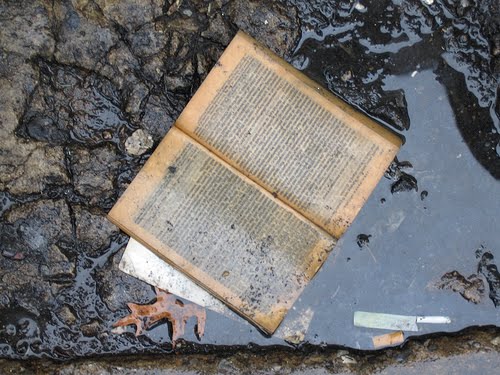
Is there a difference between an e-book and a good old-fashioned paper book?

Besides the obvious, I mean.

I admit, I am a fan of the paper book, but that is just my personal preference. That doesn't mean I think reading paper books is the right choice for everyone. Here are a few reasons I have thought of as to why people might prefer one over the other.

Perks of an e-book:

1. You can have all your books in one spot

2. It's cheaper per book

3. A Kindle is not as heavy to carry as a bunch of books

4. You can feel technologically advanced and progressive

5. Your bookmarks won't fall out

6. You can feel secure in the knowledge that you are saving trees

Perks of a paper book:

1. You can enjoy the old-fashioned format

2. You can put sticky notes inside and write in the margins

3. You can thumb through looking for a certain part

4. You can pay just for the book you want without having to buy a technological device

5. You can put it over your face when you want to sleep in a hammock

6. If it gets destroyed, you've only lost one book

You can probably think of more, but my point is that for adults, at least, it seems like digital vs. paper is mostly a matter of choice at this point. But what about for children? Children are known for often destroying paper books. In my house, we have a copy of "One Fish, Two Fish, Red Fish, Blue Fish" that I swear a fisherman went to town on or something, because half the fish are missing. Along with the covers. And a few words. Actually, a lot of words. And "The Princess Bride" is split in half right down the spine, and has another book shelved in between. And "Pippi Longstocking" is quite dogeared and naked. Poor Pippi. None of these things would happen to a Kindle. Maybe paper books aren't the best, after all.

On the other hand, if a child drops "Fox in Socks" in the bathtub, well, you've lost "Fox in Socks." But if a child drops a Kindle in the bathtub, you've not only lost "Fox in Socks," but you've lost all your books and your Kindle as well. Expensive bath. Since there are risks both ways, perhaps book format for children is also personal preference.

As you make your decision, Kindle vs. paper, feel free to choose what is most compatible with your needs and best fits your personal preference, but don't make your decision based on fear of change. Changing from one format to the other is nothing new.

We don't read scrolls anymore, and who knows... maybe someday no one will read books, either.

Thursday, February 23, 2012

You Tweet, I Whistle

Since a horde of people have suddenly started posting about their blog "tweethises," it made me wonder if I had a central message to my blog. The verdict: I do!

When I started this class, I was surprised to find it was geared almost completely toward digital technology, philosophy, information systems, government control, and other things along that line. When I took the first half of World Civ, the focus had been on the music, art, religion, literature, famous people, and other aspects of the culture, and so I was excited to start the second half because that sort of thing is very interesting to me, especially the music. I admit it - I was very disappointed to realize as the weeks went on that no thrilling exploration of world history's culture would be forthcoming. At first I moped around, feeling stuck in a class where there was such an inundation of digital focus that, while I'll be the first to agree that it's important to be on the cutting edge of understanding technology, I was drowning in too much of a good thing, and starving for lack of anything else. Then, as we talked more about self-directed learning, I realized that it was OK if I was interested in the real-life culture and people of the time periods being covered while everyone else was eager to philosophize about digital worlds, because with self-directed learning, we could learn about whatever we wanted to. I decided that I would be the voice for the cultural side of history, and everyone else could be the voice for whatever they wanted to be, and if nobody was interested in music and dancing and books, well, that was OK, and if I found out there were others who were also interested in the culture of the time periods, that would be good too, and if in the meantime I became more interested in digital philosophizing, well, that would be great as well.

So, I love music and culture, and I'll be an advocate for it even if no one else is interested, because they can be interested in whatever they want, and that's OK.

So, that's my "tweethis." Except, I don't have Twitter yet. So for now, I guess it's my theme song.